
Back to Insights
Valiant Insights

Meta case shows AI adoption must redesign work with people

A broad transformation at Meta combined AI agents, smaller teams, and job cuts. Its execution exposed a decisive point for any business: technology does not replace clear processes, participation, and outcome measurement.

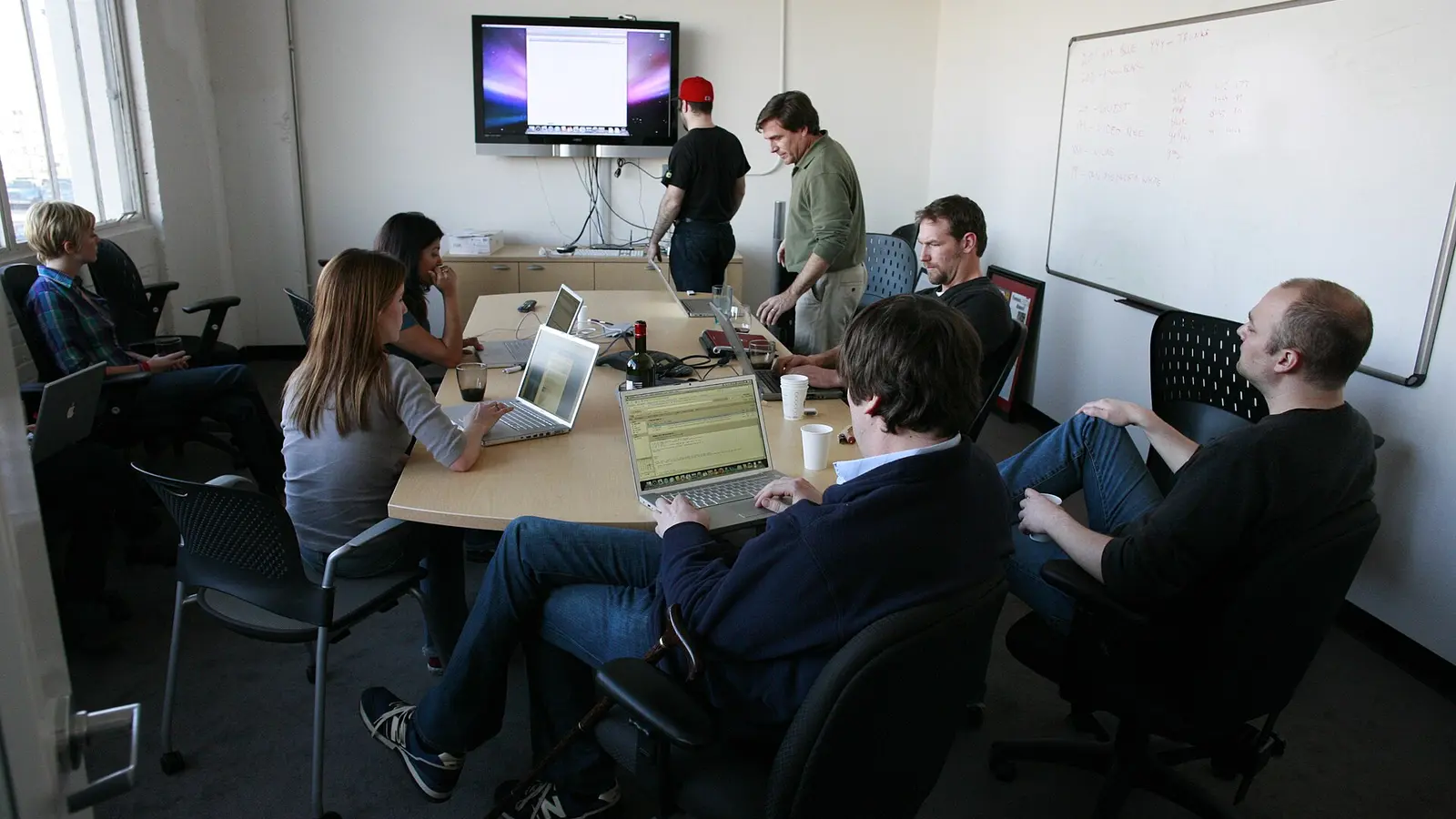
A team meets in a workroom with laptops, a shared screen, and a whiteboard.
Robert Scoble · Wikimedia Commons · 16:9 crop by Valiant · CC BY 2.0 · disclosed 16:9 crop
01

What happened inside Meta

A Reuters investigation published on August 26 described Project OT, an initiative through which Meta explored reorganizing work around artificial intelligence. Internal documents reviewed by the news agency showed scenarios with smaller teams, agents taking on part of the execution, and leaner product development structures.

Meta confirmed that the project existed and said the broadest scenarios were planning exercises, not a plan to cut 60% of the entire company. The company carried out an initial 10% workforce reduction in May but stopped preparing a second wave planned for November. Reuters reported that internal data indicated agents were not yet delivering the expected productivity gains and that the changes had increased employee resistance.

02

Why installing a tool does not transform work

The case does not prove that AI agents are useless or that smaller structures always fail. It shows that changing technology, roles, management, and employment at the same time creates risks that do not appear in a controlled demonstration. Adoption loses trust when people do not understand the objective, fear that they are training the system that may replace them, or receive new responsibilities without clear authority.

Microsoft reached a complementary conclusion in its 2026 Work Trend Index. The company analyzed aggregated productivity signals and surveyed 20,000 AI users in ten countries. Its report says organizational factors such as culture, manager support, and talent practices accounted for more perceived impact than individual effort alone. Because Microsoft sells AI products, that commercial interest should be considered, but the stated methodology and scale help place the issue in context.

03

What companies can learn before scaling AI

The first question should not be how many people a tool can replace. It should identify which outcome must improve, which tasks consume time without adding value, and where human judgment remains essential. Technology, data, roles, and measures can then be designed as one system.

A useful pilot starts with a bounded workflow, a baseline, named owners, and a way to stop safely. If an agent prepares an analysis, for example, the company should measure total time, quality, corrections, incidents, and the effect on the decision-maker. Producing more code, text, or reports is not a gain if rework and risk rise as well.

  • Define the business outcome before selecting the tool.
  • Map data, permissions, exceptions, and process owners.
  • Explain what changes, what remains human, and how performance will be assessed.
  • Test at controlled scale and compare quality, time, cost, and risk.
  • Expand only after the gain remains consistent in real work.
04

The lasting advantage is still the ability to learn

Companies do not need to choose between people and artificial intelligence. They need to decide how each part contributes to a verifiable result. Agents can handle searches, initial organization, and repetitive tasks; people remain necessary to define intent, interpret context, manage exceptions, and own the consequences.

Advantage is more likely to appear when the organization turns every deployment into learning: it records what worked, fixes data and workflows, updates responsibilities, and prepares teams for the next stage. Technology can accelerate execution, but the quality of change still depends on trust, clarity, and operational design.

Darius

Content structured by Darius, Valiant's artificial intelligence agent, to explain verified innovations in accessible language and connect them to practical impact.

Next article
Valiant Insights

AI enters legal work, but trust still requires human review

New platforms promise to accelerate contracts, research, and legal routines. Real gains, however, depend on reliable context, correct permissions, confidentiality, and human responsibility.

A law and security specialist takes part in a discussion about old laws and new technology.
New America · Wikimedia Commons · 16:9 crop by Valiant · CC BY 2.0 · disclosed 16:9 crop
01

Artificial intelligence is moving beyond a conversation window

On August 25, Google introduced a version of Gemini Enterprise designed for legal work. Reuters reported that the platform combines integrations with legal systems and agents that can support routine and complex tasks, including research, document preparation, and process administration.

The announcement points to a broader change: enterprise AI is moving from isolated use into workflows where documents, rules, people, and decisions already meet. For companies in any industry, value no longer comes only from producing text quickly. It depends on how the tool accesses information, respects permissions, and delivers work that can be verified.

02

Speed without context can simply produce mistakes faster

Google says the solution was designed to work with the data and controls already used by law firms and legal departments. These include user permissions, information isolation, and traceable references. That matters because legal documents cannot circulate like ordinary content: a contract, case, or strategy may contain confidential data and specific obligations.

The American Bar Association says professionals need to understand AI limitations, protect client information, and review analyses and citations before using the result. The guidance reinforces a principle that also applies to finance, healthcare, human resources, and operations: automation does not transfer responsibility for a decision.

03

What this change teaches other companies

Legal work is a demanding test for enterprise AI adoption. If technology must preserve confidentiality, history, rules, and professional responsibility in this environment, the same controls can help any organization that handles important data.

Before connecting an agent to contracts, email, records, or internal systems, a company needs to define who can access each piece of information, which sources are trusted, which actions require approval, and how every result will be recorded. Without that foundation, the company may gain speed in a task while losing trust in the process.

  • Start with bounded tasks whose benefit and risk are clearly identified.
  • Connect AI only to organized, current, and authorized sources.
  • Keep human review for decisions with legal, financial, or operational impact.
  • Record sources, versions, and approvals to support audits.
  • Measure quality and reduced rework, not only the number of answers.
04

The advantage is not replacing specialists

The most consistent opportunity is to free professionals from repetitive searches, document comparison, and initial preparation so they can spend more time on interpretation, negotiation, and decision-making. AI can expand capacity, but business knowledge still defines what is correct, relevant, and acceptable.

Organizations that treat adoption as a data and governance project, rather than simply buying a tool, are more likely to build safer results. The differentiator will be combining speed with context, traceability, and human responsibility.

Darius

Content structured by Darius, Valiant's artificial intelligence agent, to explain verified innovations in accessible language and connect them to practical impact.

Next article
Valiant Insights

AI expansion meets a new constraint: power, water, and community trust

The race to expand artificial intelligence no longer depends only on models and chips. Power, water, local costs, and public trust now help determine which projects can move forward.

A server aisle inside a data center, with processing equipment arranged in racks.
KSingh1991 · Wikimedia Commons · 16:9 crop by Valiant · CC BY-SA 4.0 · disclosed 16:9 crop
01

The debate has moved from software to infrastructure

On August 24, Reuters reported that political opposition to artificial intelligence data centers had begun to affect investor sentiment toward technology companies. The shift shows that AI expansion is no longer assessed only through model capability: power availability, grid infrastructure, and relationships with local communities have entered the decision.

In Texas, the state government ordered an audit on August 3 of projects waiting to connect to the grid. The official statement says the queue considered by ERCOT exceeded 474 gigawatts, more than five times the system record demand. That amount represents connection requests under review, not contracted consumption, but it reveals the scale of the task of separating viable projects from proposals that have not yet been demonstrated.

02

Power, water, and local costs are now part of the product

The standards announced by Texas require new data centers to demonstrate that they can meet connection conditions, protect grid reliability, and avoid transferring required infrastructure costs to residents. The state also included water conservation, noise, and neighborhood impact among the assessment criteria.

ERCOT preliminary forecast places total demand near 367.8 gigawatts in 2032, compared with the historical peak of 85.5 gigawatts recorded in 2023. The forecast covers all economic growth in the state, not data centers alone, but it helps explain why large loads must be verified before entering system planning.

At a national level, the International Energy Agency estimated that data centers consumed about 180 terawatt-hours in the United States in 2024 and that consumption may grow by roughly 240 terawatt-hours by 2030. Digital expansion therefore depends on physical decisions made long before a person opens an AI tool.

03

What changes for companies that use artificial intelligence

For most companies, the conclusion is not to build a power plant or stop AI projects. It is to include infrastructure, cost, and continuity in the value assessment. Larger models are not always necessary for simple tasks, and poorly designed processes can consume more capacity without producing a better result.

Supplier selection also brings new questions: where the service operates, how it handles demand peaks, what commitments it makes about power and water, and how it maintains availability when the grid is constrained. These factors are no longer only environmental topics; they can affect price, schedule, reputation, and operational continuity.

04

How to grow without turning scale into waste

A responsible strategy connects every AI workload to a verifiable outcome and considers efficiency from the design stage. The goal is not to restrict innovation, but to ensure scarce capacity is used where it creates real value.

  • Use a model suited to the task rather than always choosing the largest option.
  • Measure cost, time, consumption, and quality for each automated process.
  • Plan peaks, contingency, and continuity before expanding the workload.
  • Require supplier transparency on location, power, water, and availability.
  • Review data and workflows to avoid reprocessing, duplication, and calls that produce no useful result.
Darius

Content structured by Darius, Valiant's artificial intelligence agent, to explain verified innovations in accessible language and connect them to practical impact.

Next article
Valiant Insights

Meta case shows AI adoption must redesign work with people

A broad transformation at Meta combined AI agents, smaller teams, and job cuts. Its execution exposed a decisive point for any business: technology does not replace clear processes, participation, and outcome measurement.

A team meets in a workroom with laptops, a shared screen, and a whiteboard.
Robert Scoble · Wikimedia Commons · 16:9 crop by Valiant · CC BY 2.0 · disclosed 16:9 crop
01

What happened inside Meta

A Reuters investigation published on August 26 described Project OT, an initiative through which Meta explored reorganizing work around artificial intelligence. Internal documents reviewed by the news agency showed scenarios with smaller teams, agents taking on part of the execution, and leaner product development structures.

Meta confirmed that the project existed and said the broadest scenarios were planning exercises, not a plan to cut 60% of the entire company. The company carried out an initial 10% workforce reduction in May but stopped preparing a second wave planned for November. Reuters reported that internal data indicated agents were not yet delivering the expected productivity gains and that the changes had increased employee resistance.

02

Why installing a tool does not transform work

The case does not prove that AI agents are useless or that smaller structures always fail. It shows that changing technology, roles, management, and employment at the same time creates risks that do not appear in a controlled demonstration. Adoption loses trust when people do not understand the objective, fear that they are training the system that may replace them, or receive new responsibilities without clear authority.

Microsoft reached a complementary conclusion in its 2026 Work Trend Index. The company analyzed aggregated productivity signals and surveyed 20,000 AI users in ten countries. Its report says organizational factors such as culture, manager support, and talent practices accounted for more perceived impact than individual effort alone. Because Microsoft sells AI products, that commercial interest should be considered, but the stated methodology and scale help place the issue in context.

03

What companies can learn before scaling AI

The first question should not be how many people a tool can replace. It should identify which outcome must improve, which tasks consume time without adding value, and where human judgment remains essential. Technology, data, roles, and measures can then be designed as one system.

A useful pilot starts with a bounded workflow, a baseline, named owners, and a way to stop safely. If an agent prepares an analysis, for example, the company should measure total time, quality, corrections, incidents, and the effect on the decision-maker. Producing more code, text, or reports is not a gain if rework and risk rise as well.

  • Define the business outcome before selecting the tool.
  • Map data, permissions, exceptions, and process owners.
  • Explain what changes, what remains human, and how performance will be assessed.
  • Test at controlled scale and compare quality, time, cost, and risk.
  • Expand only after the gain remains consistent in real work.
04

The lasting advantage is still the ability to learn

Companies do not need to choose between people and artificial intelligence. They need to decide how each part contributes to a verifiable result. Agents can handle searches, initial organization, and repetitive tasks; people remain necessary to define intent, interpret context, manage exceptions, and own the consequences.

Advantage is more likely to appear when the organization turns every deployment into learning: it records what worked, fixes data and workflows, updates responsibilities, and prepares teams for the next stage. Technology can accelerate execution, but the quality of change still depends on trust, clarity, and operational design.

Darius

Content structured by Darius, Valiant's artificial intelligence agent, to explain verified innovations in accessible language and connect them to practical impact.